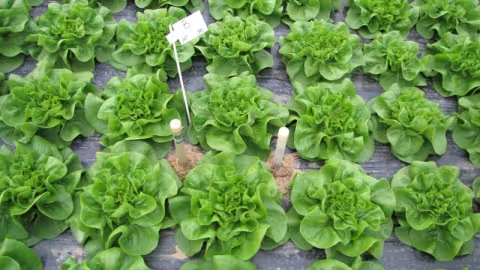
Broccoli is an annual plant of the Brassicaceae family (Cruciferae), belonging to the genus Brassica. It originates from Italy and is a fast-growing crop that can reach a height of up to 90 centimeters. In Greece, sowing usually takes place from late spring to early summer, while harvesting begins in mid-autumn. Propagation is achieved either by direct sowing in the field or by raising seedlings in nurseries, which are later transplanted once they reach a height of about 15 centimeters. There are several varieties, and the choice depends mainly on the sowing season.
Broccoli cultivation requires thorough soil preparation. For first-time establishment, it is recommended to plow the soil to a depth of 30–40 centimeters in order to improve drainage, aeration, and soil texture, which facilitates plant growth, residue incorporation, and weed control. Although broccoli can grow in a wide range of soils, it prefers fertile, well-drained soils rich in organic matter, with an ideal pH of 6–6.5. The plant is sensitive to frost and begins to show damage at temperatures below 0 °C.
Planting is usually done in rows, with distances of 40–90 centimeters between rows and 20–40 centimeters between plants. Another common method is double-row planting, where pairs of rows are spaced about 1 meter apart and the two rows within each pir are 30 centimeters apart. Seeds germinate and emerge within 6 to 10 days. Broccoli is considered a cool-season vegetable, with optimal soil temperatures for cultivation ranging between 15 and 17 °C. Its root system is relatively shallow, extending to a depth of about 45 centimeters, which makes the crop highly dependent on irrigation. Watering becomes essential immediately after planting.
The ideal ambient temperature for broccoli growth ranges between 15 and 20 °C. Sandy loam soils with adequate organic matter are considered most suitable, while sunlight is essential for photosynthesis and plays a decisive role in the final yield.
Fertilization begins with a base application prior to planting, typically using manure or compost incorporated into the soil. During crop growth, one or two additional fertilizations are required, usually with balanced or water-soluble fertilizers containing nitrogen, phosphorus, and potassium. Fertigation is considered the most efficient method, while foliar fertilizers accelerate nutrient absorption. Broccoli is sensitive to deficiencies in trace elements such as boron and molybdenum, which is why soil analysis is important to determine specific needs. Frequent, small doses of liquid fertilizer are beneficial, as they promote the production of side shoots.
Like most crops, broccoli is vulnerable to weeds, pests, and diseases. Prevention and timely management, under the guidance of agronomists and with the use of suitable plant protection products, are crucial for healthy production. The main insect pests include the cabbage white butterfly (its most significant threat), the cabbage root fly, flea beetles, whiteflies, and various lepidoptera. In addition, broccoli is susceptible to diseases such as downy mildew, alternaria, powdery mildew, clubroot, cercospora, and black rot.

Photo : Adobe stock - Irrigation must be carefully scheduled depending on the season, soil type, and stage of crop development
Irrigation must be carefully scheduled depending on the season, soil type, and stage of crop development, so that soil moisture is maintained at an optimal level. Broccoli is very sensitive to excessive humidity and deteriorates quickly when water stagnates. On the other hand, inadequate irrigation leads to reduced growth and lower product quality. Frequent watering is especially important during the early growth stages and throughout the summer months. Water requirements increase as the plant develops, with the most critical stages being germination and head formation. Drip irrigation is the most suitable method, as it minimizes water losses through evaporation and runoff while enabling simultaneous fertigation. It can be applied in both open-field and greenhouse crops, using PE pipes (Φ16 or Φ20) with emitters spaced closely apart or with independent adjustable drippers. In hydroponics, acid-resistant drippers are used, since nutrients are delivered with water along with acids in small doses to regulate pH.
Another irrigation method is sprinkler irrigation, which uses small or large radius sprinklers. This system requires high-power pumping units due to the higher operating pressures.
By adopting modern irrigation methods, growers can maximize yield while saving water and reducing overall costs. Efficiency in water use, precise flow control, cost-effectiveness, reliability, durability, and the production of high-quality irrigation systems capable of withstanding harsh conditions and delivering long-term performance are trademarks of our company.
Products :
- Driplines DRIP-PAL, SUPER-PAL, (Μαύρο & Λευκό), AGROPAL HDPE 80 and HYDROPAL PE 100
- Driplines : (PALADRIP, PALADRIP-SLIM, PALADRIP-XL, PALADRIP-FC)
- Driplines : (PALADRIP-TAPE-SD)
- Dripline Fittings, Drip Tape and Indented